

Table of contents
News
News
Posted on
09.11.2026
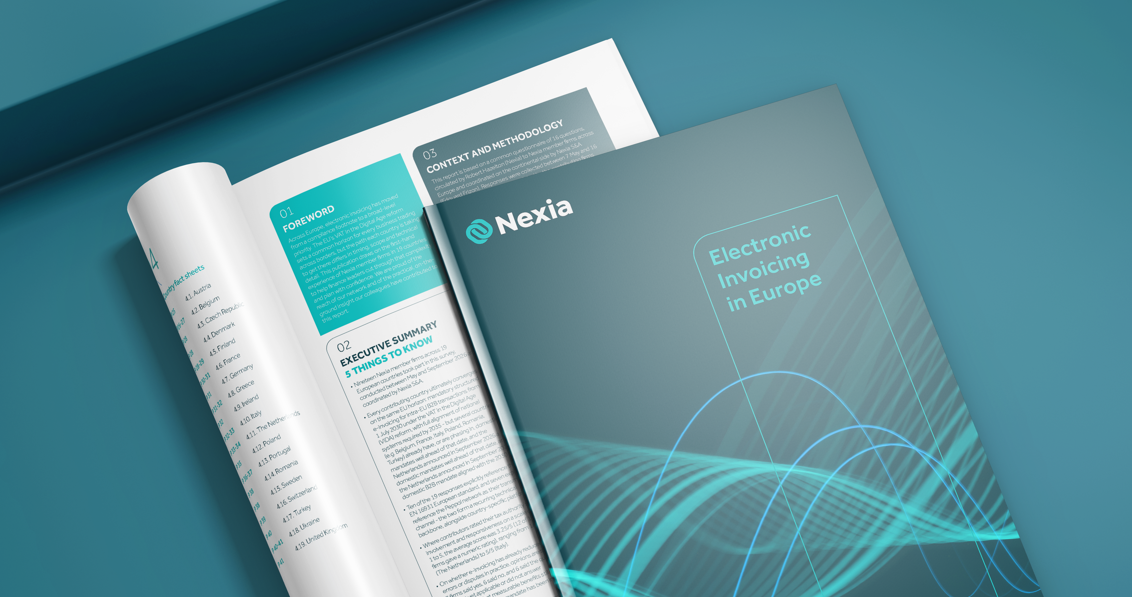
Conducted from May to September 2026 among 19 member firms of the Nexia network, the survey compares the situation in 19 European countries. Its conclusion is clear: electronic invoicing is no longer just a compliance issue, but a priority for finance departments, particularly in groups operating across multiple countries.
A common deadline, very different national schedules
Starting July 1, 2030, structured electronic invoicing will become mandatory for B2B transactions between European Union countries. Full alignment of national systems is expected by 2035. Several countries have not waited for this deadline: Belgium, France, Italy, Poland, Romania, and Turkey have already implemented or are currently deploying their own mandates. The Netherlands announced theirs in September 2026.
A technical foundation taking shape
Two references appear consistently across countries. The European standard EN 16931 is cited in 10 out of 19 responses, and the Peppol network is mentioned as a transmission channel in 7 out of 19 responses. However, national platforms continue to play a central role in several countries.
Uneven administration and benefits
The firms surveyed gave an average rating of 3.25 out of 5 for the involvement of tax authorities, with significant disparities: from 1 out of 5 in the Netherlands to 5 out of 5 in Italy. Regarding the reduction of VAT errors and disputes, opinions are divided: 7 firms answered yes, 6 answered no, and 6 believe it is still too early to say. Gains are primarily measured where the mandate has been in effect for a long time.
In France, a reform that is now operational
Since September 1, 2026, all companies must be able to receive electronic invoices, and large companies and mid-sized enterprises must issue them. SMEs, micro-businesses, and very small enterprises will be required to issue them starting September 1, 2027. The Nexia S&A teams support companies in choosing their platform, mapping their workflows, and adapting their processes.
What you will find in the report
The full report offers 19 detailed country profiles, a comparison of deadlines, mandatory formats, and transmission channels, as well as an analysis of penalty regimes. A useful tool for any company invoicing in multiple European countries.
Download the survey
Actualités
Les dernières actualités